We remain fully operational. Our teams are working around the clock to ensure your deliveries continue safely.

DOWNLOAD THE APP


Copyright © 2025 Desertcart Holdings Limited
DOWNLOAD THE APP
Buy anything from 5,000+ international stores. One checkout price. No surprise fees. Join 2M+ shoppers on Desertcart.
Desertcart purchases this item on your behalf and handles shipping, customs, and support to Honduras.
🔥 Unleash Your Inner DIY Master with SEEKONE!
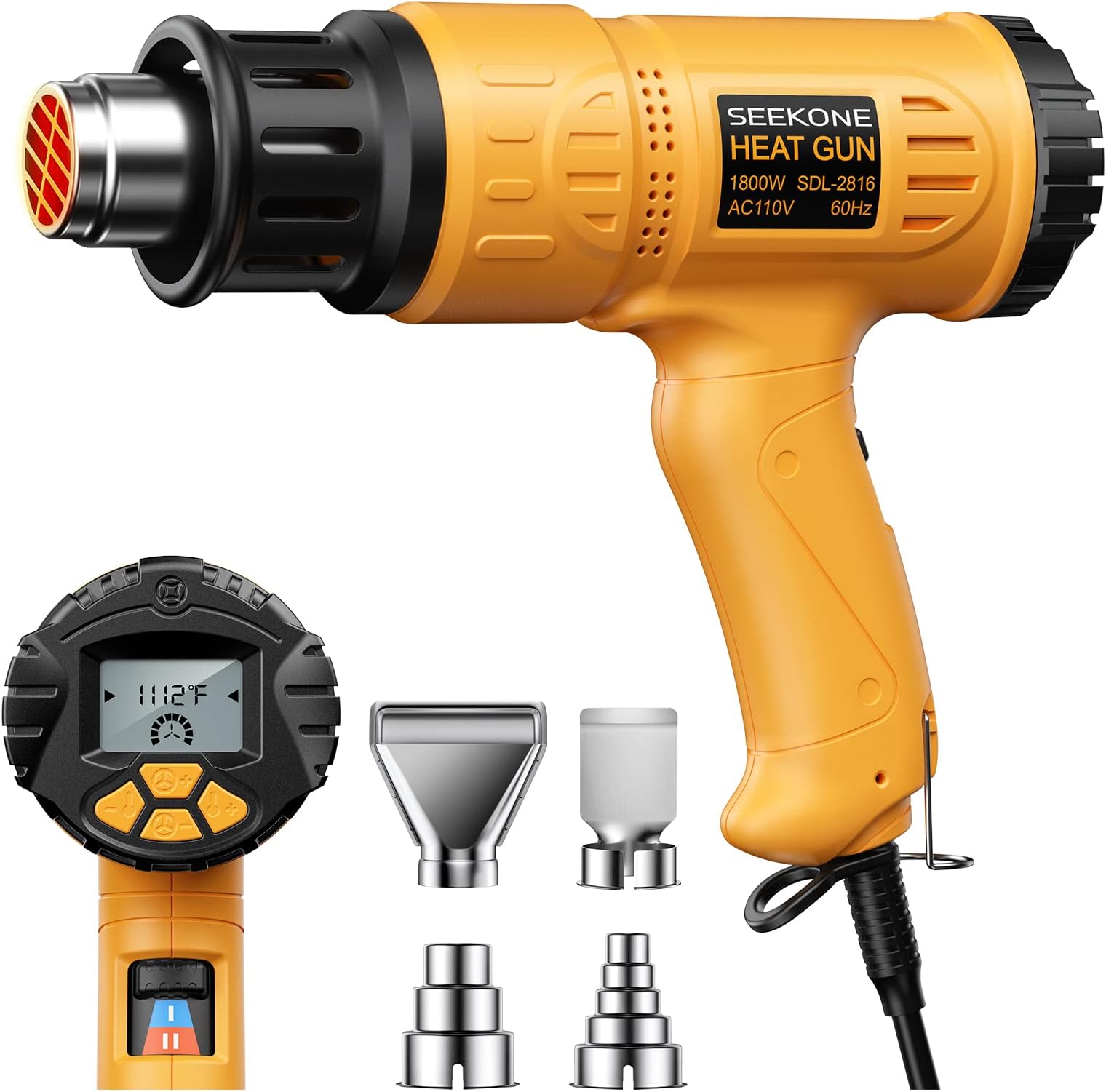
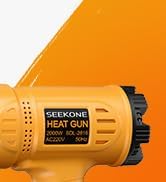
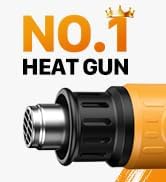
The SEEKONE 1800W Hot Air Gun Kit is a powerful and versatile tool designed for home improvement and restoration projects. Featuring a large digital LCD display, variable temperature settings from 122°F to 1112°F, and a memory function for convenience, this heat gun is perfect for tasks like paint removal, bending pipes, and more. With safety features like overheat protection and a power-off delay, it ensures both performance and longevity. The ergonomic design and included accessories make it an essential addition to any DIY enthusiast's toolkit.





















| ASIN | B07YDS9HWX |
| Batteries Included? | No |
| Batteries Required? | No |
| Best Sellers Rank | #50,360 in Tools & Home Improvement ( See Top 100 in Tools & Home Improvement ) #59 in Soldering Heat Guns |
| Color | Yellow |
| Cord Length | 1.4 Meters |
| Customer Reviews | 4.6 4.6 out of 5 stars (1,410) |
| Date First Available | September 26, 2019 |
| Item Weight | 2.02 pounds |
| Item model number | SDL-2816 |
| Manufacturer | SEEKONE |
| Material | ABS + Stainless |
| Package Dimensions | 10.59 x 9.06 x 3.03 inches |
| Part Number | SDL-2816 |
P**.
Outstanding heat gun
This heat gun has performed flawlessly over the last year despite the use it has seen. The digital controls work well and the LCD screen is visible in all light conditions. The plastic case is durable and hardly shows any wear no matter how many times it has been dropped, kicked, dragged across the floors or stepped on. I couldn't ask for more from a heat gun at this price point.
R**N
Hot Item!
I bought this with the intention of melting ice that forms on my rain chains. It doesn't work as well as I'd hoped. But I use it for that purpose outside on very cold days. Probably most of the heat is dissipated in the air, and maybe some is absorbed by the chain. The ice melts slowly right in front of the nozzle, but refreezes as it makes its way down the chain and ice below. But it does get nice and hot. Probably works well for other applications. Hopefully, one day I'll have one of those, and will put it to better use.
B**W
Good Hot Gun
Works advertised! Recommend
J**Y
Good product
Works good
B**M
Excellent for paint removal. Beats chemicals tht we tried on other projects.
Bought home new in 1985. Cabinets weere natural wood and finished with polyurethane. Twenty years ago We decded to paint them white. Didn't strip nor scan the original wood finish. This time we are doing the entire home interior and decided to do it the right way. Suggest you also buy this amazing tool from Amazon. Premium Ergonomic Carbide Scraper,2-1/2",Scraper Tool for Removing Varnish, Paint, Glue, Resin, Dry Glaze, Stains, Putty, Scratch. It's perfect for stripping finish and relatively easy. The carbide blade has two sides if one gets dull. Ours remains sharp after the kitchen cabinets were completed. The heat gun has digital heat control which is excellent. Remove hinges and pulls. When paint bubbles in the heated area begin scraping. No wood was burned. The door in the photo was scraped, but not fine sanded until it wasready for a primer coat. The wood was primed with KillZ primer which is available on Amazon. Do some research before choosing which product in the family will. work best. Truth is important! At first it took about an hour to do both sides of each door. I recommend doing this in garage or outside. Consider getting new drawer / door pulls and hinges for the project. Amazon has good choices.
P**T
Good low cost heat gun
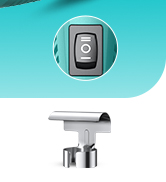
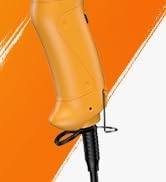
I use heat guns quite often, mostly for applying heat-shrink tubing, and bending PVC tubing and pipe. For these applications, I have a couple professional heat guns by Milwaukee, with accurate digitally controlled fan speed and heat control that can be variably set and then the gun adjusts to maintain the setting. But those cost a few hundred dollars, and I wanted a couple inexpensive basic heat guns for my home shop and garage. I decided upon two different models by Seekone, a less expensive one with simple thermostatic control, and a somewhat more expensive (yet still inexpensive) model that is the subject of this review, which adds a digital temperature readout and solid-state setting of fan speed and temperature. So, about this fancier model (see my other review of the basic model). It is a classic utilitarian device with a solid, decent quality appearance and feel. It seems like something that will hold up well to light use, but I don't know if I would either trust it for any kind of production level work, or to last for many years of regular use. The housing is all plastic, with practically the only metal visible being the hot air nozzle, which by the way is approximately 1-1/2" diameter. The housing from the rear/base to the end of the nozzle is about 9-3/4", the diameter of the body is about 2-3/4", and the handle (including the power cord strain relief) extends about 7" below the body of the gun. The heavy duty power cord is about 56" long, and its strain relief included a loop which I presume is to allow hanging the gun on a hook (although not to be actually used that way). The gun is rated to be 1800W, and it could hardly be any more than that since that gets you to about 15A, the maximum on most 120VAC single phase power outlets. The gun is specified for 110VAC rather than 120VAC, although that should not be of great importance, and only 60Hz is mentioned, which should only influence fan speed, so I don't know if the gun's fan could be damaged, or work poorly, at 50Hz. The gun can be held, well, gun-like in one hand and aimed at the object to be warmed/heated, and the case & handle design make this mode fairly comfortable, with a good balance and other ergonomics. But the plastic is all hard, with none of the soft-finish we have become accustomed to with many power tools, so this probably makes extended use without wearing gloves somewhat uncomfortable. The other mode is to balance the gun on its rear-end/base, with the nozzle pointing up, so you can use both hands to hold the object to be heated in the air stream above the nozzle. This is a test for many heat guns in my experience, because many have a tendency to tip over, and because this can easily start a fire, they need to be closely watched when used this way. This also can show where the money was saved to get the low cost.....my Milwaukee models use something like a silicon rubber jacketed power cord with high strand count conductors inside, so the power cord is soft and floppy, with minimal stiffness, so the weight and/or stiffness of the power cord, coupled with the greater weight of the gun, make it more stable in this mode. By comparison, this Seekone gun is very light weight, and the power cord, while electrically adequate, is also inexpensively made, and is quite stiff. I found that I had to adjust the position and orientation of the gun until I found a stable place to let it balance while in use, and another other position or rotational orientation on a floor or table would result in the power cord's stiffness pulling on the low mass of the gun, so it would just fall over immediately. My Milwaukee guns have the ends of their handles at the same level as the rear base of the gun's housing when used in vertical mode, and this also helps stabilize the gun. On this Seekone gun, the handle itself cannot be used this way, but they DID include a wire bail that snaps into two holes near the end of the handle. Normally, the bail rests against the back of the handle, but you can flip it to another position where is acts to extend the handle such that it touches the same surface that the gun is balanced on, making it more stable in that direction; this does help to offset the stiffness of the power cord, at least in one direction. The gun comes with four accessories, all of which modify the airflow out of the nozzle: - Concentration nozzle, 2" long, reduces the normal 1-1/2" diameter nozzle down to 7/8" diameter - Concentration nozzle, 2" long, reduces the normal 1-1/2" diameter nozzle down to 1/2" diameter - Reflector nozzle, 2" long, redirects the air from the nozzle to one side (the shovel shaped sheet metal piece is about 1-1/2" wide). The reflector as furnished is fairly flat, but you could potentially bend it to redirect the air differently, or even curl it around something like a dowel to make a looped shape (many other heat guns come with just such a nozzle, best for evenly heating heat shrink tubing around electrical wiring) - Deflector nozzle, 3-1/2" long and 2-1/4" wide, flattens the hot air stream and directs it to one side; this is probably for stripping paint The gun has two controls: - Three position POWER switch, OFF, LOW (I), HIGH (II) - LCD-pushbutton control panel that actually forms the rear base of the gun (the gun rests on the control panel when in vertical mode) The single-sheet User Manual is fairly well illustrated, but the English text does not always make sense, and there are some flat-out incorrect instructions and descriptions. I will now describe what I have learned empirically while using my gun. The LCD display on the control panel is about 1-1/4" x 7/8", and it is not backlit, which can often make it somewhat hard to read. But at this prince point, I am not complaining. Below the LCD are four yellow pushbuttons; FAN + and -, and TEMPERATURE + and -. The control panel works in conjunction with the three position POWER switch, which contrary to what the instructions describe, appears to be actually a range and memory/preset selector, and NOT a fan speed control (on the less expensive version of this gun, that same switch is indeed the combined fan speed control and power switch). You select either LOW (I) or HIGH (II) range with the POWER switch. It seems that the only difference is that in LOW (I), the maximum temperature you can set is 750°F, while in HIGH (II) you can set temperatures up to 1100°F. One in either of those two range settings, you press the FAN + or FAN - buttons to increase or decrease the fan speed, and the speed changes instantly; it then remains where you set it and seems to not change automatically. A circular bar graph on the LCD illustrates where your speed setting is within the possible range of speeds. Then you press the TEMPERATURE + or TEMPERATURE - buttons to select the desired temperature. Normally, the LCD displays the actual measured temperature, but when you are pressing the buttons the LCD changes over to displaying your latest SETTING instead of the actual temperature. Pressing these buttons momentarily increments or decrements the temperature setting by 10°F. Holding down either of these buttons will rapidly change the temperature setting in rapid hundred degree steps. So basically you first hold down a button to quickly get to the nearest 100 degree setpoint, and then momentarily press the same button repeatedly to close in on the desired setpoint by tens; pretty intuitive and fast. After you have not pressed a TEMPERATURE button for a couple seconds, the LCD changes from displaying the setting, and starts showing the actual temperature, and you can see it rapidly increase or decrease until the setpoint is reached, and then the digital circuitry holds it there. It seems quite stable at that point, and you can still freely change the fan speed as desired; if you make a rapid fan speed change, you might see the actual temperature displayed dip for a couple seconds before it stabilizes again. You can then select the other range, e.g. HIGH (II), and make another set of fan speed and temperature settings, and once again the display will then show the gun rapidly adjusting until the desired temperature is reached. You can then change back and forth between the LOW (I) and HIGH (II) ranges, and the gun will remember your settings for that range and quickly adjust to meet them. Again, it seems that the ONLY difference between the two ranges is the maximum possible temperature setpoint. The LCD can be set to display temperature in either Fahrenheit or Celcius (Centigrade). Unintuitively, you press BOTH the FAN + and FAN - buttons at the same time for a few seconds to switch between the two units (it would have been more intuitive to press both TEMPERATURE buttons). The instructions, AND a large label on the gun itself, remind you to always turn the gun off by moving the POWER switch to OFF, after which the digital controller will keep the fan running for about 8 seconds to cool off critical components. You are adjusted to never unplug the gun until this automatic cool down has completed. I note that on the simpler non-digital version of this heat gun, there is no such automatic cool down and no such warning. I wonder of the thing that needs to cool down is actually some part of the solid-state controls, rather than the fan or heating element.... BTW, most heat shrink tubing is polyolefin, and the normal recommended shrink temperature for that is about 200°F, so the LOW (I) range is appropriate, and the fan speed can also be set fairly low as well.
K**E
Quality heat gun
Easy to use and settings are helpful.
M**.
I just finished converting my liquid cooled PC from soft to hard tube and I wanted a heat gun with temperature display to be used when bending the PETG pipes. This heat gun did the job perfectly. I especially appreciated that the temperature is remembered between uses and I don't need to set it each time. Also nice is the auto cool-down when you turn off the gun. This heat gun is priced well and performs as I'd hoped. I can definitely recommend it.
M**Z
Muy buena excelente potencia
R**.
Works great, way better than the cheaper ones.
A**O
Controles: increíbles Rango de temperatura: increíble Calidad de construcción: buena Precio: increíble La compré para soldar geomembrana y funcionó de lujo. No es necesario comprar las pistolas especializadas para esta función que son mucho más caras
A**O
La usamos a diario en un taller de serigrafía. A penas llevamos dos meses utilizándola y ha funcionado de maravilla. Esperemos que siga así ☺️🙌🏻
Trustpilot
1 month ago
2 months ago